
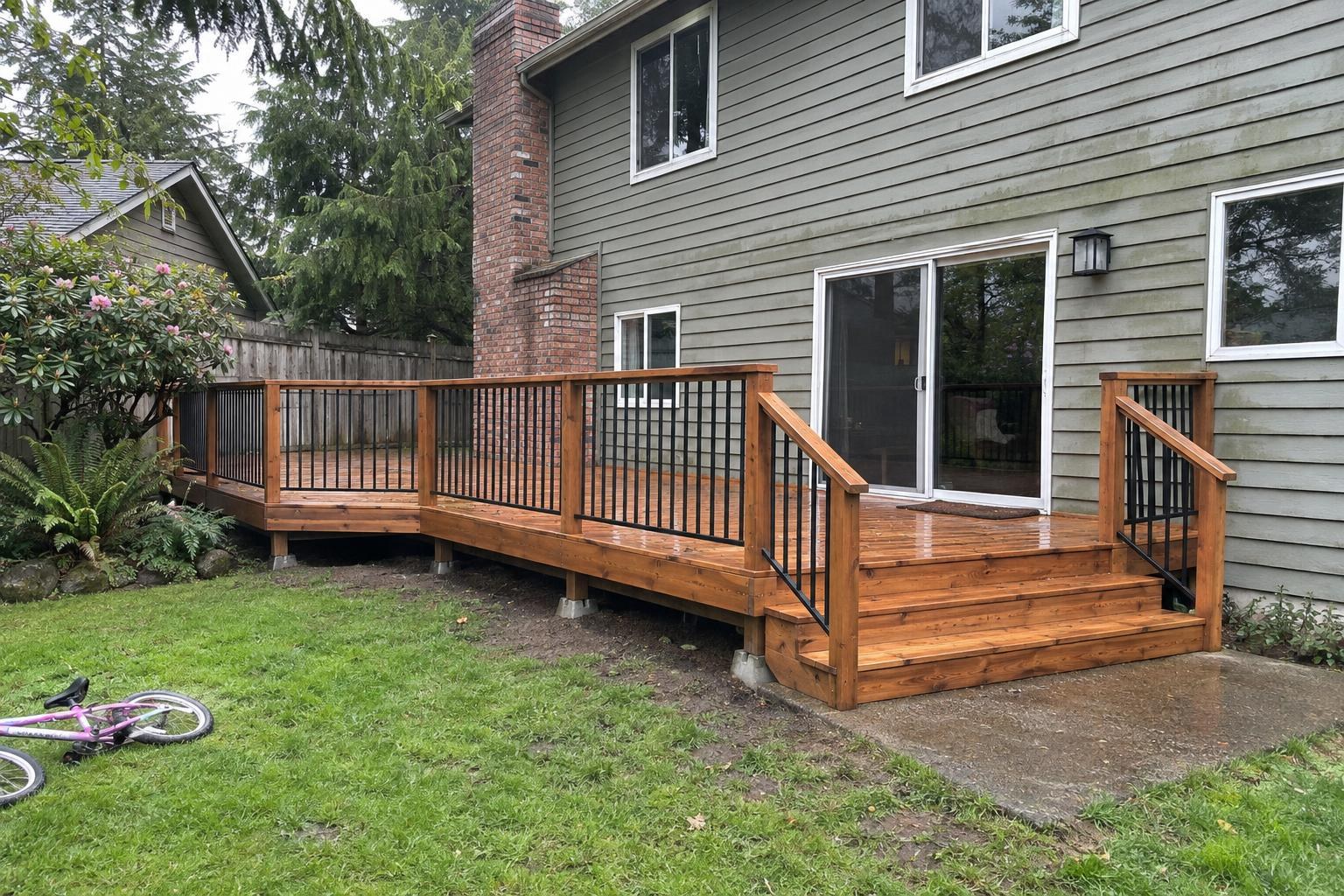
Bremerton sits on glacial till, gets soaked from October through April, and has a lot of houses built into hillsides overlooking the Sound or the Narrows. None of that is a problem for a deck builder who knows what they're doing. All of it is a problem for one who doesn't. Before you hire anyone, it helps to know what the good ones talk about without being asked, and what the bad ones hope you never bring up.
Ask how the ledger board attaches to the house. This is the single most telling question you can ask a deck builder, because it's the part that fails catastrophically if it's wrong. The ledger is the board bolted to your house rim joist that the whole deck hangs off. It needs to be through-bolted or lag-screwed into the framing, not just nailed, and it needs flashing above it, typically a metal Z-flashing tucked under the house's weather barrier so water runs over it and not behind it. If a bidder starts talking about joist hangers and decking before they've said a word about how the ledger is flashed, that's worth noticing. Rot at the ledger connection is the most common reason decks fail in this part of the state, and it's almost always a water intrusion problem that started with bad or missing flashing.
Footings have to deal with Kitsap ground, not somewhere dry
Frost depth around here is shallow compared to inland states, but code still calls for footings down 12 to 18 inches depending on soil and location, set below the frost line and resting on undisturbed soil, not fill. A lot of Bremerton's older neighborhoods, Manette and the streets up around Charleston, sit on slopes, and a deck built on a hillside lot often needs engineered footings rather than the standard poured concrete pier. If a contractor hasn't asked about your lot's slope or soil before quoting a price, they haven't actually planned the job yet. They've guessed.
Drainage matters more here than in drier states because water sitting against a post doesn't evaporate in December, it just sits there for five months. A gravel base under each footing and concrete that stands a couple inches proud of grade keeps posts from wicking up moisture all winter. It's a small detail that costs almost nothing to do right and costs a post replacement to skip.
Permits, and who's actually responsible for them
Work inside Bremerton city limits goes through the city's building department. Parts of the area that are technically unincorporated Kitsap County, out toward Gorst or Illahee, go through the county instead. A contractor who works here regularly knows which one applies to your address without having to look it up. The permit should be pulled in the builder's name, not yours, because that's who's liable if an inspector finds the footings weren't deep enough or the ledger wasn't flashed. A deck over roughly 30 inches high, or any deck attached to the house, almost always needs a permit here, and that typically means at least a footing inspection before concrete goes in and a framing inspection before the decking boards go down. If a contractor suggests you skip the permit to save time or money, that's not a shortcut, that's them asking you to take on their risk. Lots near the water, along Port Washington Narrows or Sinclair Inlet, can also trigger shoreline review, which adds time to the schedule and is worth asking about up front rather than finding out mid-project.
What they build it out of, and whether they explain why
Pressure-treated Douglas fir is the standard framing material here and it's fine, but the chemical treatment (ACQ, most commonly) corrodes plain galvanized fasteners over a few years. Hangers and screws touching treated lumber need to be hot-dip galvanized or stainless, not the cheaper electro-galvanized hardware that shows up rusted within a season. For the visible decking, cedar looks good and smells better, but it needs restaining every 2 to 3 years out here given how much moisture and moss pressure the wood sits under most of the year. Composite costs more up front and never needs staining, but it still needs proper joist spacing, usually 16 inches on center, sometimes 12 for certain brands, or the boards sag between supports. A builder who walks you through these tradeoffs instead of just pushing whichever material pads the invoice is one who's thinking about your deck ten years out, not just at handoff.
Red flags worth walking away from
- A quote with no mention of permits, inspections, or who's pulling them.
- Pressure to pay the full amount upfront, before any lumber is on site.
- No certificate of insurance when you ask for one. Ask for one.
- A bid that's dramatically lower than every other one you got, with no explanation for the gap. Usually it means thinner footings, no flashing, or lumber a size down from what the span actually calls for.
- Nobody willing to put the scope, materials, and payment schedule in writing.
A fair quote in Bremerton for a straightforward ground-level deck usually runs a few weeks from signed contract to finished boards, weather allowing, and the weather doesn't always allow. Concrete footings need a minimum of about 48 hours before they can bear load, longer in cold, wet stretches, and a builder who tries to frame the same day they pour isn't giving the concrete a chance to cure. Multi-level decks, pergolas, or anything on a steep lot takes longer, sometimes a couple of months once design and permitting are factored in. Anyone promising a big custom build in a week is either overstaffed in a way that should worry you about quality, or not planning to do it right.
None of this is complicated once you know what to listen for. A deck builder who talks about ledger flashing, footing depth, and fastener corrosion before you've even asked is someone who's dealt with what this climate does to a deck over the years. That's the conversation worth having before you sign anything. If you're weighing a new build, a repair, or just want someone to look at what's already there, you can see the kind of work we do at Ashford Construction Group.